
In today’s rapidly evolving digital marketplace, you’ll often hear two terms tossed around: SEM vs SEO. But what do they really mean? And more importantly, how do they differ and why does your business need both? At SEO Business Company, we believe that understanding SEM vs SEO is critical if you want to build a sustainable, high-visibility online presence. In this article we’ll walk you through the definitions, key differences, the benefits of combining them, and how to build an integrated approach that works in 2025.
What is SEM and What is SEO?
Let’s begin with the fundamentals of SEM vs SEO.
SEO stands for Search Engine Optimization. It is the process of optimizing your website its content, structure, technical aspects, and backlink profile so that it ranks better in the organic (non-paid) search results of search engines like Google, Bing, and others.
SEM stands for Search Engine Marketing. It is a broader discipline: whereas SEO is purely organic, SEM includes both organic and paid search marketing efforts, such as pay-per-click (PPC) advertising, display ads triggered by search intent, and other efforts to increase search visibility.
In many modern usages, when people say SEM vs SEO, they treat SEM as the paid-search component (sometimes called PPC), contrasting it with the organic side (SEO). Either way, for businesses, it’s less a question of “SEM vs SEO” and more “how can we combine SEM and SEO effectively”.
Why the Debate “SEM vs SEO” Matters
The interplay of SEM vs SEO matters for your business for several reasons:
Budget and timelines differ significantly depending on whether you focus on SEM or SEO.
The type of traffic and target keywords vary between paid and organic search channels.
The sustainability of results is different: SEO builds long-term accumulative value, while SEM can deliver rapid results but stops when you stop spending.
For businesses in 2025 and beyond, digital visibility requires a smart mix of both.
Understanding SEM vs SEO is no longer optional it’s a necessity if you want to stay competitive in the digital race. At SEO Business Company we guide our clients to leverage both sides strategically.
Key Differences in the “SEM vs SEO” Comparison
Here’s a comparative breakdown of SEM vs SEO, so you can clearly see how they differ and complement each other.
This table should help clarify the core distinctions in SEM vs SEO, and why you should not choose one exclusively but rather combine both for optimal results.
Why You Need Both SEM and SEO (Yes, It’s Not “SEM vs SEO” It’s “SEM + SEO”)
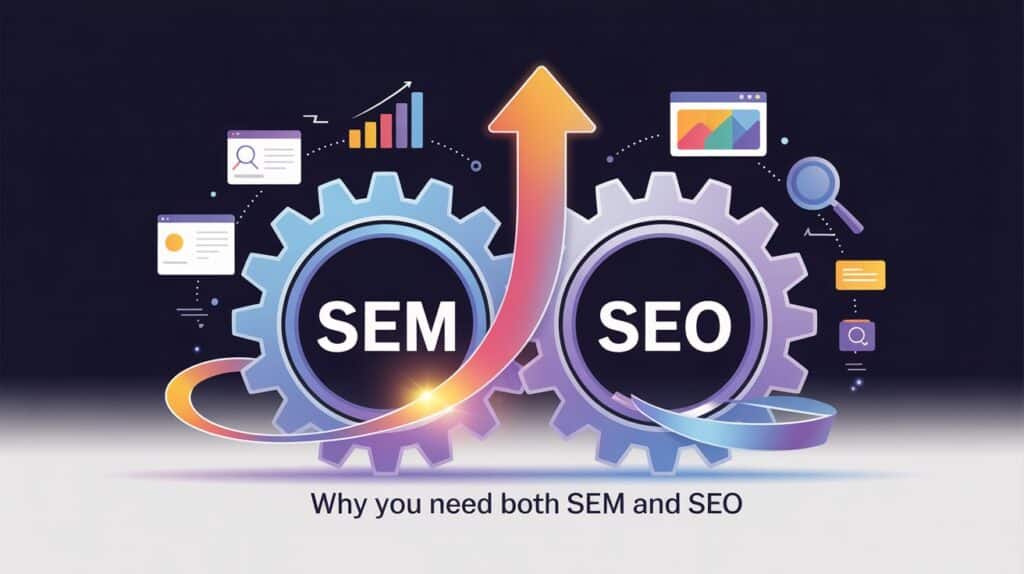
At SEO Business Company, we emphasise that the conversation should move beyond “SEM vs SEO” into “SEM and SEO working together”. Here’s why your business truly needs both.
1. Immediate vs Long-Term Gains
If you launch a new product or campaign and need fast visibility, SEM is highly effective you can create ads to target specific keywords, drive traffic and conversions rapidly. However, if you rely only on SEM, once you stop funding the ads, your visibility drops. Meanwhile, SEO builds organic authority over time and gives you enduring positioning in search engines. Combining them gives you immediate traffic (SEM) and lasting presence (SEO).
2. Data Synergies
Insights from SEM pay-per-click campaigns (which keywords convert, what ad copy resonates, what landing page works) can feed into your SEO strategy. Likewise, your SEO keyword insights, content performance and backlink profile can strengthen your SEM campaigns. This synergy between SEM vs SEO ensures that both channels inform one another.
3. Coverage of the Full Funnel
Often, users are at different stages in the purchase journey. Some are research-oriented, some ready to convert. SEO content can capture research-level queries (“how to choose X product?” etc), while SEM ads can target high-intent transactional keywords (“buy X product online”). By implementing both SEM and SEO, your business captures users across the funnel.
4. Budget Diversification & Risk Mitigation
Relying solely on one channel (just SEO or just SEM) introduces risk. Algorithm updates can hurt SEO positions; budget cuts can halt SEM visibility. Having both gives balance. In effect, rather than “SEM vs SEO”, the question is “how much mix of SEM and SEO works for my business?”
5. Competitive Advantage
Many businesses treat SEM and SEO as alternatives but those who treat them as complements gain advantage. At SEO Business Company we help clients integrate both into one unified search-marketing strategy, so they are not “SEM vs SEO” but “SEM + SEO” working in harmony.
How to Build an Integrated SEM + SEO Strategy
Given that you want more than just “SEM vs SEO” and want both working together, here are practical steps to build the integrated strategy:
Start with SEO Foundation
Before spending heavily on paid search, ensure your site has a strong SEO foundation:
Keyword research that aligns with business goals (including organic and paid keywords)
On-page optimization: meta titles, descriptions, headings, alt text, URL structure
Technical SEO: mobile-friendly, fast page load speed, secure (HTTPS), clean site architecture
High-quality content that addresses user intent (informational + transactional)
Backlink building and internal linking to build authority
Launch SEM Campaigns for Immediate Impact
With your foundation in place, launch SEM campaigns:
Set a budget, identify target keywords (especially those with high intent)
Create landing pages tailored to those ads (and ensure they meet the same quality standards as your SEO pages)
Use precise targeting (device, location, demographics) to optimize spend
Track performance metrics: clicks, cost per conversion, quality score
Use Insights from SEM to Feed SEO Strategy
Analyze which keywords and ad copy convert best in SEM
Identify content gaps or landing pages that can be turned into long-form SEO content
Use paid search data to refine keyword prioritization for organic content
Use SEO Gains to Optimize SEM Costs
As organic rankings improve, you may reduce reliance on paid ads for those terms and reallocate budget
Use organic content to support landing page relevance, which can improve ad quality score and reduce cost per click
Continually monitor both channels since search algorithms change, and ad auctions get more competitive
Continuously Test, Measure & Optimize
Because you’re combining SEM vs SEO efforts, you need an ongoing process:
Run A/B tests on ads and landing pages (SEM)
Perform content audits and refreshes regularly (SEO)
Monitor analytics: traffic sources, conversion paths, cost per acquisition, lifetime value
Adjust the balance between SEM and SEO based on seasonality, budget, and business goals
How SEO Business Company Did It for a Client
Let’s illustrate with a simplified example of how we at SEO Business Company helped a mid-sized e-commerce client navigate SEM vs SEO to boost visibility and sales.
The Challenge
The client had a new product line and limited organic visibility. They needed fast traction (so strong SEM) but also wanted sustainable traffic to avoid escalating ad spend every month.
The Approach
We started with an SEO audit and optimized the site’s technical performance, and launched high-quality content targeting long-tail keywords.
Simultaneously, we set up a SEM campaign for the new products, bidding on purchase-intent keywords to generate immediate sales.
We monitored which keywords produced the highest return in paid campaigns and fed those insights into our SEO content plan (creating blog posts, FAQs, landing pages).
Over time, as organic content gained ranking, we scaled down some of the SEM spend for those terms and reallocated to new product launches.
The result: within 6-12 months, the client saw both consistent organic traffic (via SEO) and optimal paid-search performance (via SEM) illustrating how SEM vs SEO is actually a synergistic relationship.
Key Takeaways
The paid ⇒ organic feedback loop accelerated results
The client didn’t treat SEM and SEO as separate silos but as parts of a unified strategy
The phrase “SEM vs SEO” shifted internally to “SEM & SEO”
Budget efficiency improved over time as organic visibility reduced reliance on paid clicks
The Future of SEM vs SEO in 2025 and Beyond
Looking ahead, the debate around SEM vs SEO continues to evolve thanks to changes in search engine algorithms, consumer behaviour, and advertising technology. Here are some trends to watch:
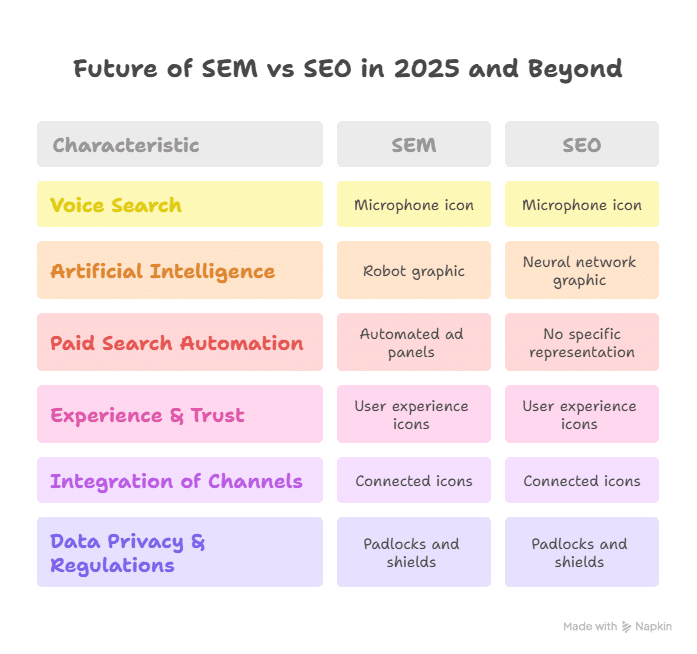
Voice search & AI: With more users using voice assistants and AI summarization, SEO needs to adapt to conversational queries meaning keyword strategies and content formats will change.
Paid search automation: SEM platforms are increasingly automated (smart bidding, responsive search ads, etc). The difference between paid and organic efforts may blur further, but the need for fundamentals remains.
Experience & trust become more critical: Organic rankings will increasingly reward UX signals (mobile friendliness, site speed, content depth) so SEO efforts need investment. Paid campaigns must align with high-quality landing experiences.
Integration of channels: The distinction of SEM vs SEO will become less meaningful businesses will focus on “search engine marketing” as a holistic discipline, blending paid, organic, social, and voice.
Data privacy and regulatory changes: With more restrictions on tracking, the way we optimise both SEM and SEO will shift, making first-party data and strong content even more important.
For companies like SEO Business Company, advising clients means staying ahead of these changes and ensuring we don’t treat SEM and SEO as isolated tactics but as integrated strategies.
Common Mistakes to Avoid When Navigating SEM vs SEO
When businesses focus on SEM vs SEO in silos, common mistakes arise. Here’s what to watch out for:
Launching SEM campaigns without a strong SEO foundation: This can lead to high ad spend but low conversion because the landing pages or site experience are weak.
Focusing only on SEO and ignoring paid search: If you delay paid search when you really need fast visibility or product launch traction, you may miss opportunities.
Treating keywords in paid search and organic search separately: Failing to share insights between SEM & SEO teams wastes potential.
Not tracking and measuring both channels together: If you only look at paid click stats or organic rankings separately, you miss the holistic view of how your search engine marketing is performing.
Assuming that what works for SEM will automatically work for SEO (and vice versa): Content for paid landing pages may not always translate to organic success make sure you adapt strategy accordingly.
Frequently asked questions (FAQs)
1.What is the difference between SEM vs SEO?
At its simplest, SEO is about earning organic visibility in search results without paying for each click, while SEM encompasses paid search (and often organic) efforts to increase search visibility. The debate “SEM vs SEO” is really about understanding how the two differ—but in practice your business should deploy both for maximum impact.
2.If I have a small budget, should I focus on SEO or SEM?
If budget is tight and you can afford to wait months for results, SEO is a strong foundation because its ongoing costs are lower. But if you need fast traffic (e.g., product launch, seasonal promotion), a smaller SEM spend can give quick results while you build SEO. The answer is not “SEM vs SEO” but “how much budget for each and when”.
3.How long will it take to see results from SEM vs SEO?
With SEM (paid search) you can see traffic within hours or days of launching a campaign. With SEO, it typically takes several months to see meaningful organic ranking improvements and traffic increases. The trade-off in SEM vs SEO is speed versus sustainability.
4.Can we stop SEM once organic rankings (SEO) improve?
Yes, you might shift budget away from certain paid keywords once organic rankings are strong. However, many businesses maintain both. Even if you rank organically, paid ads can still capture additional traffic or dominate paid market share. So the question moves from “SEM vs SEO” to “SEM + SEO: what’s the right blend?”
5.How do we measure performance when using both SEM and SEO?
Key metrics include: click-through rate (CTR), cost per acquisition (CPA) for ads, organic traffic growth, keyword ranking improvements, conversion rate by channel, and lifetime value of a user. Monitor both paid and organic traffic side-by-side to see holistic ROI. This helps you answer the “SEM vs SEO” question in terms of which investment gives better return for your business goals.
6.Are there industries where SEM is more effective than SEO (or vice versa)?
Yes for industries with high competition or high cost-per-click (CPC), SEM may be expensive and long-term organic ranking (SEO) may yield better ROI. Conversely, if you’re launching a time-sensitive offer, SEM may deliver faster conversions. In either case, don’t treat “SEM vs SEO” as an either/or; combine accordingly.
7.How do we allocate budget between SEM vs SEO?
Allocation depends on your business goals, timeline, competition and existing search presence. A typical approach: invest in SEO for long-term growth, allocate a portion of budget to SEM for immediate traction. Adjust allocation as organic visibility improves and ad performance stabilises. The key is to avoid viewing “SEM vs SEO” as zero-sum; invest in both at appropriate levels.
Conclusion
In 2025, mastering the balance between SEM and SEO is no longer optional it’s a strategic necessity. While SEO builds long-term credibility and organic growth, SEM delivers instant visibility and measurable results. The key is not choosing one over the other, but understanding how both work together to amplify your digital marketing impact.
By integrating SEO’s sustainable foundation with SEM’s targeted precision, businesses can achieve consistent website traffic, higher conversion rates, and stronger brand authority. As AI, voice search, and data privacy trends reshape the digital landscape, those who invest in both SEM and SEO will stay ahead of the competition and capture lasting online success.
At SEO Business Company, we specialize in creating customized strategies that merge the best of both worlds helping your business rank higher, reach wider, and grow faster in an ever-evolving digital era.

SEO Business Company is a trusted digital marketing partner in India, delivering result-driven SEO, PPC, and AI-powered strategies.We help businesses boost visibility, build credibility, and achieve sustainable growth in the competitive digital landscape.