

Introduction:
Why Traditional SEO Is No Longer Enough
For more than two decades, Search Engine Optimization (SEO) has been synonymous with Google. Marketers optimized websites to rank on search engine results pages (SERPs), focusing on keywords, backlinks, and technical performance. While SEO remains critical, the way people search for information has fundamentally changed.
Today, users don’t just search on Google.
They search on:
- YouTube for tutorials
- Amazon for products
- TikTok and Instagram for trends and recommendations
- Chatbots and AI assistants for instant answers
- App stores for solutions
- Voice assistants like Alexa and Siri
- Community platforms like Reddit and Quora
This shift has given rise to a new, more holistic discipline: Search Everywhere Optimization.
Search Everywhere Optimization (often abbreviated as SEOx) is the practice of optimizing your brand, content, and digital presence to be discoverable across all search-enabled platforms, not just traditional search engines.
In this article, we’ll explore what Search Everywhere Optimization is, why it matters, how it differs from traditional SEO, and how businesses can implement it to stay competitive in an increasingly fragmented digital ecosystem.
What Is Search Everywhere Optimization?
Search Everywhere Optimization is a strategic approach to digital visibility that ensures your brand appears wherever users search for information, products, or solutions—regardless of platform, device, or format.
Instead of asking:
“How do we rank on Google?”
Search Everywhere Optimization asks:
“How do we get discovered wherever our audience is searching?”
This includes:
- Search engines (Google, Bing, DuckDuckGo)
- Social platforms (TikTok, Instagram, LinkedIn, X)
- Video platforms (YouTube)
- Marketplaces (Amazon, Etsy, App Store, Google Play)
- AI-driven search tools (ChatGPT, Perplexity, Gemini)
- Voice search devices
- Forums and communities
- Review platforms
- Maps and local search
Search Everywhere Optimization is not about replacing SEO—it’s about expanding it.
Why Search Everywhere Optimization Matters More Than Ever
1. User Search Behavior Has Fragmented
The modern user journey is non-linear. A single buying decision might involve:
- A TikTok video for inspiration
- A Google search for comparisons
- Amazon reviews for validation
- A YouTube tutorial for confidence
- A chatbot query for quick clarification
If your brand is only optimized for Google, you are invisible in most of that journey.
2. Social Platforms Are the New Search Engines
Younger generations increasingly use social media as search tools:
- TikTok for “how-to” and discovery
- Instagram for local businesses and lifestyle searches
- LinkedIn for B2B research
- Reddit for honest opinions
Search Everywhere Optimization ensures your content is structured, labeled, and distributed in a way that makes it discoverable inside these ecosystems.
3. AI Is Redefining How Answers Are Delivered
AI-powered search tools don’t just list links—they synthesize answers. If your content is not:
- Structured
- Authoritative
- Clear
- Well-distributed
It may never be referenced or cited by AI systems.
Search Everywhere Optimization includes optimizing for machine readability, not just human consumption.
4. Competition Is Increasing, Attention Is Decreasing
Ranking #1 on Google is harder and often less impactful than it used to be. SERPs are crowded with ads, featured snippets, videos, and AI summaries.
Being present everywhere increases:
- Brand recall
- Trust
- Touchpoints
- Conversion probability
Visibility across platforms compounds over time.
Search Everywhere Optimization vs Traditional SEO
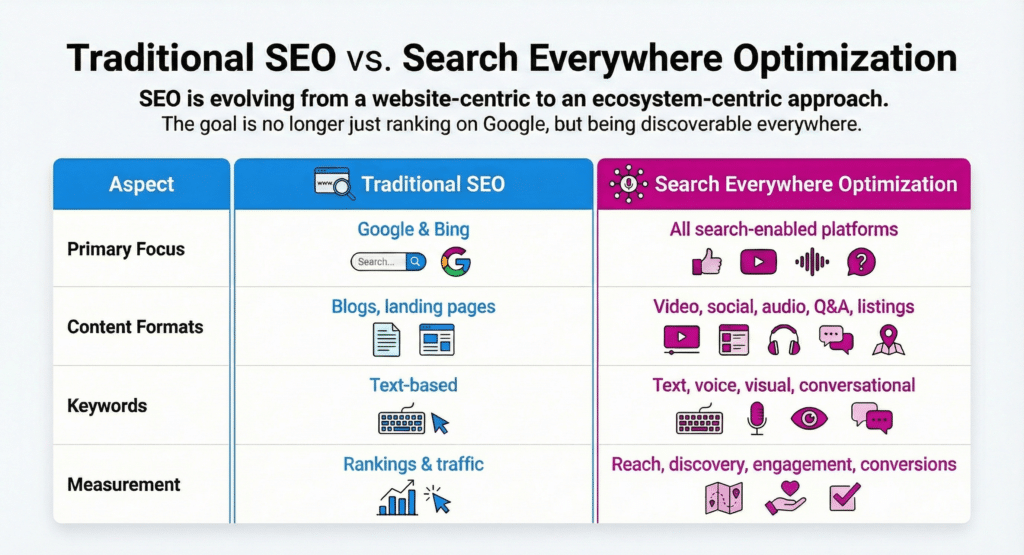
Traditional SEO is foundational. Search Everywhere Optimization is evolutionary.
Core Pillars of Search Everywhere Optimization
To implement Search Everywhere Optimization effectively, you need to think in terms of interconnected pillars rather than isolated tactics.
1. Audience-Centric Search Mapping
Search Everywhere Optimization starts with understanding where your audience searches.
Key questions:
- Which platforms does your target audience trust?
- Where do they research, compare, and decide?
- What type of content do they consume on each platform?
For example:
- B2B SaaS buyers may search on Google, LinkedIn, G2, and ChatGPT
- Gen Z consumers may search on TikTok, YouTube, Instagram, and Reddit
- Local customers may rely on Google Maps, Apple Maps, and reviews
Each platform requires a tailored optimization approach.
2. Platform-Specific Content Optimization
Every platform has its own “algorithmic language.”
Google & Search Engines
- Long-form authoritative content
- Structured data
- Page speed and UX
- Backlinks and topical authority
YouTube
- Optimized titles and descriptions
- Engagement signals (watch time, comments)
- Clear thumbnails
- Spoken keywords for captions and transcripts
TikTok & Instagram
- Short-form, high-retention videos
- Keyword-rich captions
- On-screen text
- Trending formats and sounds
Marketplaces
- Product titles and descriptions
- Reviews and ratings
- Visual assets
- Category relevance
Search Everywhere Optimization means translating your core message into each platform’s native format.
3. Content Atomization and Repurposing
One of the most efficient ways to scale Search Everywhere Optimization is content atomization.
A single core asset can become:
- A long-form blog post
- Multiple short-form videos
- Carousel posts
- Email snippets
- Podcast talking points
- Community discussion threads
- AI training references
This ensures:
- Consistent messaging
- Lower content costs
- Maximum reach
- Faster authority building
4. Conversational and Voice Search Optimization
As voice assistants and AI chat tools grow, search queries become:
- Longer
- More conversational
- Question-based
Examples:
- “What’s the best CRM for small businesses?”
- “How do I improve website conversion rates?”
- “Which marketing strategy works best for startups?”
Optimizing for Search Everywhere means:
- Writing in natural language
- Answering questions directly
- Structuring content with FAQs
- Using clear, concise explanations
5. Brand Entity Optimization
Modern search engines and AI systems recognize entities, not just keywords.
Your brand should be clearly defined across the web with:
- Consistent name, description, and messaging
- Author profiles
- About pages
- Social profiles
- Citations and mentions
The stronger your brand entity, the more likely you are to:
- Appear in AI answers
- Be trusted across platforms
- Rank faster and more consistently
Search Everywhere Optimization and AI Search
AI search tools are changing discovery at a fundamental level.
Instead of showing 10 blue links, AI systems:
- Analyze multiple sources
- Extract key insights
- Present synthesized answers
To be included, your content must be:
- High quality
- Factually accurate
- Well-structured
- Authoritative
- Widely referenced
Search Everywhere Optimization helps ensure your content:
- Exists across multiple trusted platforms
- Is consistently aligned
- Builds credibility signals AI systems rely on
This is not about “gaming” AI—it’s about becoming a reliable source of truth.
Measuring Success in Search Everywhere Optimization
Traditional SEO metrics alone are not enough.
Key metrics to track include:
- Platform-specific visibility
- Content reach and impressions
- Engagement rates
- Brand mentions
- Referral traffic
- Assisted conversions
- AI citation presence
- Community growth
Success is not just ranking—it’s being discoverable wherever decisions are made.
Common Mistakes to Avoid
- Treating all platforms the same
Each platform requires a unique content and optimization strategy. - Chasing trends without strategy
Visibility without alignment doesn’t drive results. - Ignoring brand consistency
Inconsistent messaging weakens trust and authority. - Focusing only on short-term metrics
Search Everywhere Optimization is a long-term compounding strategy. - Neglecting content quality
No optimization can compensate for low-value content.
How to Get Started with Search Everywhere Optimization
If you’re new to this approach, start with these steps:
- Audit where your audience searches
- Identify your core content pillars
- Optimize your website as a foundation
- Expand into 2–3 high-impact platforms
- Repurpose and adapt content
- Track performance holistically
- Iterate based on data and feedback
You don’t need to be everywhere overnight—but you do need a roadmap.
The Future of Search Is Everywhere
Search is no longer a single destination—it’s an ecosystem.
As platforms evolve, algorithms change, and AI reshapes discovery, the brands that win will be those that:
- Understand their audience deeply
- Show up consistently across platforms
- Deliver real value in every format
- Build trust over time
Search Everywhere Optimization is not a trend—it’s the new standard.
Those who embrace it early will dominate visibility, relevance, and growth in the years ahead.
Final Thought
If SEO helped brands win the last decade, Search Everywhere Optimization will define the next one.
The question is no longer:
“How do we rank?”
It’s:
“How do we get found—everywhere it matters?”

SEO Business Company is a trusted digital marketing partner in India, delivering result-driven SEO, PPC, and AI-powered strategies.We help businesses boost visibility, build credibility, and achieve sustainable growth in the competitive digital landscape.
3 Responses